Loading...

Store sign dimensions are one of the most critical technical decisions when implementing brand identity at a point of sale - yet they're often overlooked until after the sign has already been installed. A sign that's too small looks weak and fails to attract attention; one that's too large looks unbalanced and may even violate outdoor advertising regulations.
There is no single fixed size that works for every store. The optimal dimensions depend on a combination of factors:
The storefront width is the primary deciding factor. The industry standard is for the sign to occupy roughly 70–85% of the storefront width, ensuring visual balance while leaving clearance on both sides. For a 4m-wide facade, the ideal sign width falls between 2.8m and 3.4m.
The mounting height directly affects visibility from a distance. A sign installed 3–4m above ground level needs a minimum panel height of 60–80cm so the lettering is large enough to read comfortably from 10–15m away.
The sign type also influences dimensions. Mica lightbox signs are typically slim and compact, allowing for longer spans. Standalone raised inox lettering requires spacing calculations between characters, while flex banner signs can be made much larger for a comparable cost.
Local regulations cannot be ignored. Under Decree 181/2024/NĐ-CP, storefront signs must not exceed the permitted facade area, and approval from the district-level People's Committee is required if the sign area exceeds the regulated threshold.
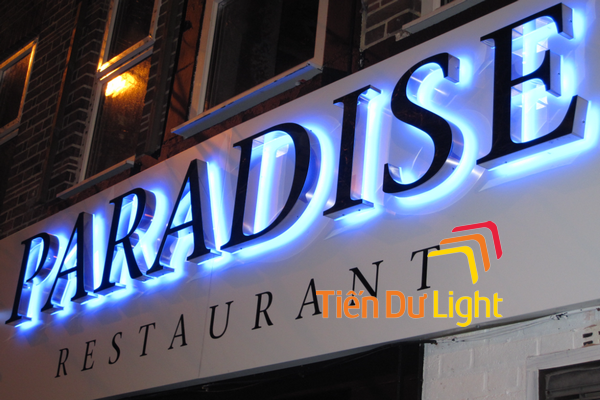
Standard shop sign sizes
The following size guidelines are drawn from hundreds of real-world projects across multiple industries:
Fashion & Beauty Retail
Fashion and beauty brands typically prefer signs with a smaller height (40–60cm) but greater width, creating an impression of elegance and refinement. Raised inox lettering on an aluminum composite or tempered glass backing is the most common material combination.
F&B — Restaurants & Coffee Chains
F&B signage needs to stand out and remain clearly lit at night, typically using mica lightboxes or aluminum lightboxes with backlit logos. Sign height is greater than in fashion retail because it needs to carry the logo, brand name, and sometimes a tagline.
These practical guidelines help you determine appropriate dimensions before working with a sign manufacturer:
The 70–85% rule: The sign should occupy 70–85% of the storefront width. Placing it flush against both side walls creates a cramped, unattractive look; leaving too much space makes the sign look isolated and disconnected from the overall facade.
Letter height proportional to viewing distance: The basic formula is letter height (cm) = viewing distance (m) × 3. This means that for a customer standing 5m away, the minimum letter height should be 15cm to read comfortably.
Minimum clearance from ground level: The bottom edge of the sign should be at least 2.5m above ground, ensuring it is not obstructed by pedestrians, vehicles, or other facade elements.
Logo-to-brand-name ratio: When designing the sign, the area ratio of the logo to the brand name should be 1:2 to 1:3, so both elements are clearly readable from a distance. A logo that's too small loses brand recognition; one that's too large obscures the store name.
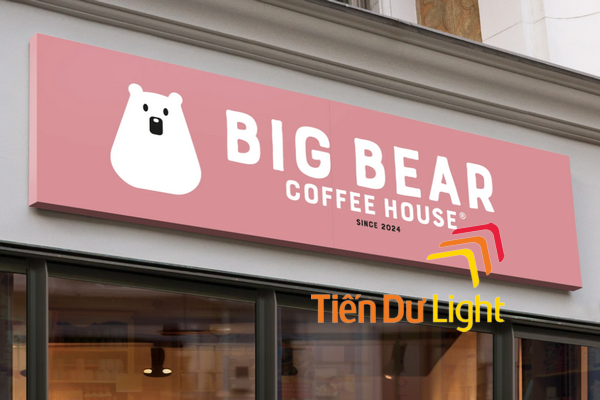
How do I choose the right size for my shop sign?
After more than 15 years of installing signs for thousands of businesses, Tiến Dư Light has observed the same mistakes recurring most often:
Making the sign too small to cut costs: The result is a sign that doesn't stand out - customers walk past without noticing the store. The cost of replacing it with a properly sized sign ends up being higher than if it had been done right the first time.
Not measuring the actual facade before ordering: This is the most common cause of signs that don't fit after installation, requiring trimming or supplemental additions - creating extra cost and delays to the opening schedule.
Ignoring other facade elements: Air conditioning units, pipes, windows, and balconies all affect the usable space for sign installation. A full facade survey is necessary before finalizing the design.
Not accounting for sightlines from both directions: Pedestrians approaching from the left and from the right see the sign at different angles. For narrow facades or signs set back in an alley, the sign's angle or dimensions may need to be adjusted to optimize visibility from both directions.
There is no universal formula for store sign dimensions - but the right size can be determined precisely once you have the key parameters: facade width, mounting height, expected viewing distance, and the sign type appropriate for your industry. If you're preparing signage for a new store or standardizing the identity system across a chain, Tien Du Light's technical consulting team is ready to conduct an on-site survey and recommend the right standard dimensions for your specific situation.
Receive the latest information about our products, promotions, and news.
Head Office: Số 58 đường Thanh Quả, thôn Sinh Quả, xã Bình Minh, TP. Hà Nội
Phone Number: 0961.514.739 - 0904.692.277
Southern Branch: 106 Đông Minh, Phường Đông Hòa, Thành Phố Hồ Chí Minh
Phone Number: 0345.439.055
Email: Contact@tiendulight.com
Hotline: 0961.514.739 (Miền Bắc ) - 0345.439.055 (Miền Nam) - 0904.692.277